Your adventure with the world of scents began with collecting miniature men's perfumes at the age of 13. Do you still collect them?
No, that's in the past. I kept three little bottles – Shiseido Tactics, Halston Z-14 and Etienne Aigner Silver. They're a dozen, even several dozen years old. I managed to obtain them in their original mini bottles. They stand under my computer monitor like small relics. The rest – hundreds of miniatures – I gave to a friend who collected them as well.
Why those three in particular?
I have a strong sentimental attachment to those scents, and today none of them exist anymore. Halston, for example, was the first fragrance in history to use ISO E Super – and at as high a concentration as eight percent.
What makes a thirteen-year-old start collecting scent samples?
My father was an art teacher. He used to send postcards to various companies asking for material samples. And those companies responded. Adhesives, wood, plastic and other strange things he used in his work would arrive. I was a little envious of those "gifts." I noticed in women's magazines that by perfume ads there were strange addresses – "Depot Düsseldorf" or "Depot München" – and I thought: "Hey, I like perfumes, I'll try asking them for samples." I wrote postcards to various brands and, hard as it is for me to believe now, every day after school there were two or three parcels waiting for me. It was like Christmas every day. I opened the packages and inside were scent samples from different parts of the world. A stamp cost forty pfennigs, so even a child could afford it. I bought a few postcards, sent them off and entered the world of scents almost for free. Eventually I had three shelves filled with samples. I would come home and smell. And when you do that every day from the age of thirteen – by necessity you become an expert.
When did that childhood fascination turn into a real dream of becoming a perfumer?
I was sixteen when I met Dagmar Skopalik, the daughter of the president of the largest perfumery company in Germany – Haarmann & Reimer. It was a complete coincidence: a holiday in Wiesbaden, she was staying one floor up at an acquaintance of my father's. I brought her a package from the postman, we started talking. I said I dreamed of becoming a perfumer. She smiled and said: "That's funny – I'm the daughter of the boss of Haarmann & Reimer." I was stunned. She gave me a contact at the company. The next day I took a train and went to Holzminden. Of course I didn't have an appointment, but I insisted that I wanted to talk to a perfumer. They scheduled me… for six months later. After my final exams they offered me a job. Could you dream of a better start?

What attracted you to the profession of a perfumer?
I was fascinated by the complexity of perfumes. I wanted to understand how they are made, to learn their language. I quickly realized that the whole architecture of a scent comes down to three levels: top, heart and base. Our job as perfumers was to combine these elements into a coherent whole. I remember asking my teacher, Mr. Oakers – a man to whom I owe a lot – whether he could imagine a fragrance made of one single molecule. He reacted immediately: "Absolutely not." He was outraged, because no one had dared to question that paradigm before. No one had thought to pour one molecule into a bottle and call it perfume. So when Escentric Molecules appeared, reactions were extreme. Half the community accused us of a fraud. But for me it was an act of liberation – a return to the essence of scent, to its pure core. And although it took me years to reach that point, I knew that this was my voice.
Do you remember what you felt when you first smelled the ISO E Super molecule?
I'll never forget it. ISO E Super is not just a smell, it's a physical experience. You inhale and you feel: "Yes. This is it." It has something narcotic about it, something that makes you want to have this scent with you all the time.
As if you suddenly saw more? Felt more?
Exactly. Except you don't feel it with every breath. ISO E Super has a saturation effect – it blocks olfactory receptors, so it seems to disappear. But it's there. Your nose just stops registering it. That's why many people say: "I don't smell it on myself." But after a while only others notice it – those who have just entered the elevator with you.
So the scent habituates the owner's nose but not the noses of others?
Exactly. It's a paradox: you stop sensing it yourself, but others pick it up very clearly. If you're the only person wearing Molecule 01 in a room – you are noticeable. It's a scent that leaves a trace. Baccarat Rouge works similarly, which was created in 2014. There, too, it's about a few carefully chosen synthetic ingredients. Their common trait? Longevity and impact on the senses. It's only five molecules – among them as much as 30% ISO E Super. Sometimes less really is more and it's enough to create a legend.
What exactly do we feel when we smell ISO E Super?
A delicate and subtle scent. But the most interesting thing is how it acts on our senses. Today we know that this molecule stimulates one of the few pheromone receptors we still have. We used to have many more, but they began to disappear in the course of evolution. By comparison, a mouse has over two hundred, because it still communicates by scent. We as a species took a different path, but these receptors are still in us, albeit dormant. And ISO E Super hits exactly those receptors.
In the perfume industry ISO E Super was rather an additive to give sensuality to compositions, right?
It was actually treated as a modern, synthetic woody note. It was used instead of patchouli, vetiver or cedar to give the fragrance a more contemporary sound. And you have to admit: it played a huge role in the history of perfume. Fahrenheit contained 25% ISO E Super, Trésor – 20%, and Féminité du Bois as much as 40%. There were also compositions based almost exclusively on this molecule – like the aforementioned Halston, which had 8% of it. That was already a bold move at the time. But that's how it is with every new molecule: at the beginning it's used in high concentrations. If the market reacts well, if people not only aren't afraid of it but actually love it – it stays. ISO E Super was created in 1973 in IFF laboratories. To this day no natural equivalent has been found. Although… I once had a strange story.
Tell me.
It was in Argentina, mid-'90s. I went to the Iguazú Falls. I saw a tree there – Igu de la India, it looked like a wild fig. I picked a fruit, returned to the hotel. I had an empty Coca‑Cola bottle. I filled it with water, put the fruit in and left. When I came back a few hours later, the room smelled of ISO E Super. To this day it's a mystery to me.
When did you think: "Alright, we're doing Molecule 01!"?
September or October 1990. I was working at Haarmann & Reimer then. I was just starting out, learning ingredients, experimenting. I gave a friend a sample of ISO E Super and we went to a bar together. And suddenly… something happened. People started turning around. They asked: "What is that scent?", "Who smells like that?". My friend was surprised, I even more so. It was just one molecule, and it acted like a magnet. That's when I understood: one molecule is enough. But from that first thought to realization fifteen years passed. I watched the market, matured to the decision, waited for the moment when the world would be ready. The idea was born in 1990, but it materialized only in 2005. Even then it was a leap into the unknown, something completely new.

I love this scent. I've been wearing it since it appeared in 2006 at Galilu. I fell in love with it, although I'll admit that at first it was strange and incomprehensible.
Many people had a similar reaction. Because Molecule 01 was a scent completely against the grain.
I remember in the '90s I took this project to Diesel – a brand that at the time liked to break patterns. But even there I heard: "This is too much. Even for us."
I had to wait until a space appeared that could accommodate something different. That space came only at the beginning of the 2000s, when Frédéric Malle launched his brand and places like Galilu appeared. Earlier the niche practically didn't exist. I remember a meeting at Harvey Nichols – we came with Molecule 01 to a buyer we reached through an acquaintance. She smelled the fragrance, sprayed her wrists, looked at us and casually said: "Let's keep in touch." The next day she called and asked for a meeting herself. After our meeting she got into a taxi and the driver went crazy – he bombarded her with questions: "What is that scent?", "What do you smell like?". She was in shock because she herself felt nothing. That was the moment. People with open minds began to believe in us. A niche was being born.
In which direction do you think the world of scents is heading now?
Strong, heavy scents will certainly not disappear. They will stay with us forever, because there will always be people who want to be more "noticeable." But increasingly I have the impression that everything related to perfume – advertising, strategy, sales, and above all price – is completely detached from what is actually in the bottle. One has little to do with the other. Marketing has become more important than content. It creates the impression of dealing with something exceptional. Today this is standard practice – the hustle. The end result? The illusion of luxury. The very notion of niche is changing too. Today it's less and less an alternative. Big brands copy what independent brands created. Everyone now has their "artistic line." These collections are no longer a tribute to originality, but a business calculation.
Is there any contemporary and complex scent you admire?
I probably admire Estée Lauder Aliage the most. A breakthrough scent from the '60s – animalic, fresh, spicy, floral. It had everything. In the USA it was marketed as a "sport fragrance," although it wasn't that at all. Heavy, herbal (thyme, basil) and very complex. I once worked on recreating it during training. I wanted to understand what was in it. And to this day I can smell it in my nostrils.
Do you remember a scent that left a mark on your heart, not just on your skin?
It was more of a situation. An evening in a perfumery in Italy. A woman smelled M + Iris and burst into tears on the spot. She said she had dreamed her whole life of smelling like that and had never been able to find it. That really moved me. I was standing in front of the perfumery and had tears in my eyes myself.
Which smell does your nose hate the most?
Coriander. I can tolerate a little in Thai food where there's intense chili, lime and garlic. But if someone dumps half a kilo of coriander on a tomato and cucumber salad – I can't stand it.
Does the nose know more than the eyes?
Definitely. Smell is the most emotional of our senses. The problem is that today we function mainly through sight. We look at phones, computers, TVs all day. Everything is visual. Survival based on images. And yet two hundred years ago people had to trust their nose. A mother could tell by smell whether food was fresh. She could sense if danger was nearby. She knew which fruits were ripe and which were not. The nose decided survival. Today we no longer have to do that. Worse, we don't even want to. In one study conducted in the UK, people aged 15–25 were asked whether they would trade their sense of smell for a smartphone. Half answered: "Of course." And that's terrifying. Because if that's how we really think, it means the end of our relationship with the world. The end of our relationship with ourselves.
If you weren't a perfumer, what would you be?
I would definitely have gone into industrial design. My father was an art teacher, and I grew up in Kassel – a city of contemporary art. From childhood I made jewelry, prints on T‑shirts. I always looked for a form that breaks the pattern. That's why design seemed like a natural path. But I didn't take that route because I heard from Haarmann & Reimer: "Don't study chemistry – come to us." And that's what I did.
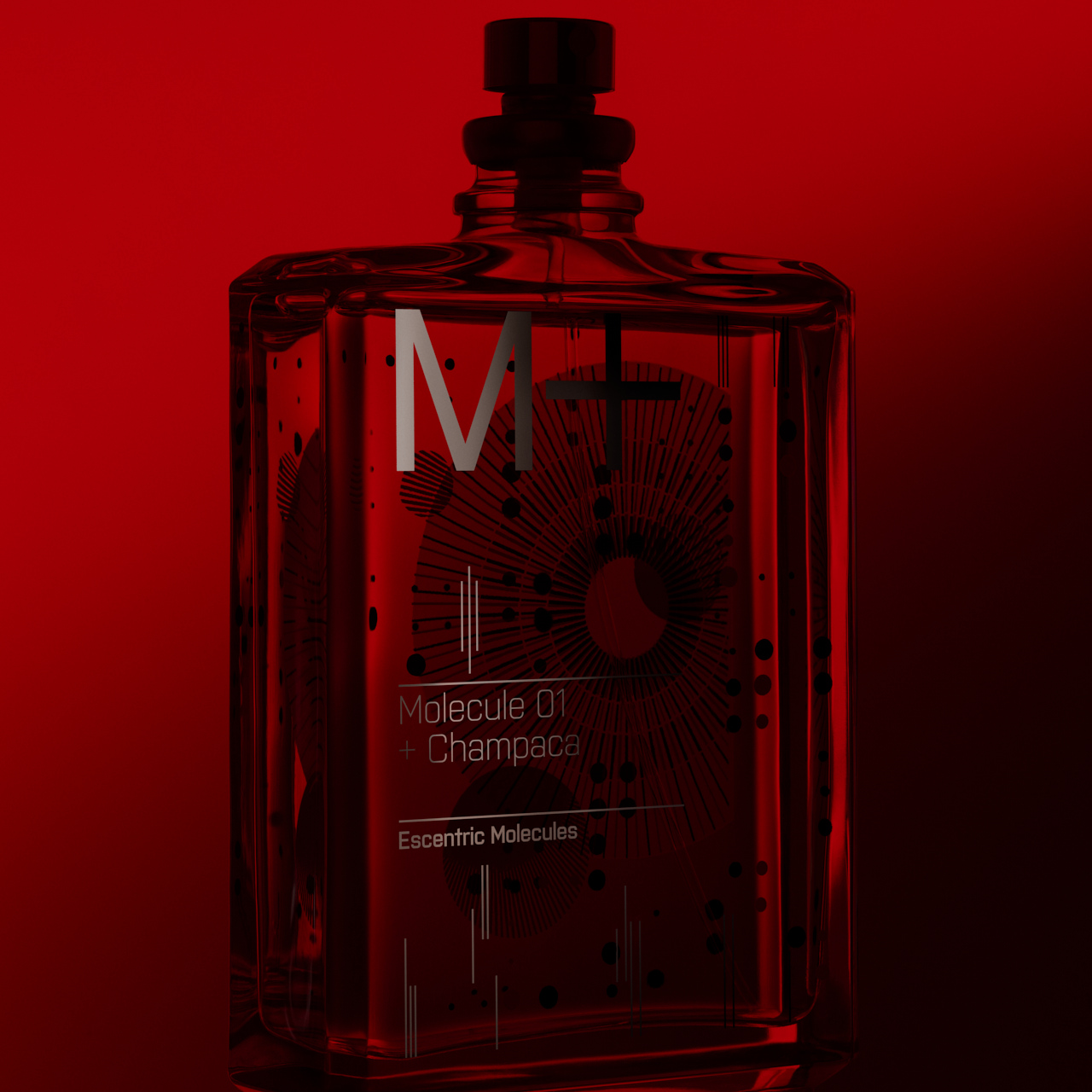
What do you smell like today?
Cologne, which I always compose myself for the summer.
And do you wear Molecule 01?
No. Never. To be honest, I have never worn them.
Never?
Never. Although… it's funny. My wife – before we even met – wore Molecule 01.









































 Proceed to Checkout