O zapachu
Olfactory cultures. The Dogon, Desana and Ongee tribes.
Can we today, in a contemporary world almost entirely subordinated to visual centrism, imagine regions of the world where smell becomes the dominant sense?
Text: Zuzanna Sokołowska
17 • 04 • 2023
Today, in a contemporary world almost entirely subordinated to visuality, can we imagine regions of the world where the most important sense becomes smell? Although it is hard to believe, it is possible. The authors of the book Aroma.The Cultural History of Smell Constance Classen, David Howes oraz Anthony Synott argue this. They describe, among others, the Desana tribe inhabiting the Amazon Rainforest, the Ongee people originating from the Andaman Islands, and the Dogon from Mali. A characteristic feature of the indigenous inhabitants of these regions is an attachment to the sense of smell, which constitutes an essential element in ordering their reality, building identity, and moral values.
The Ongee greeting formula is wildly surprising – they greet one another by rubbing noses, asking whether everything is all right.
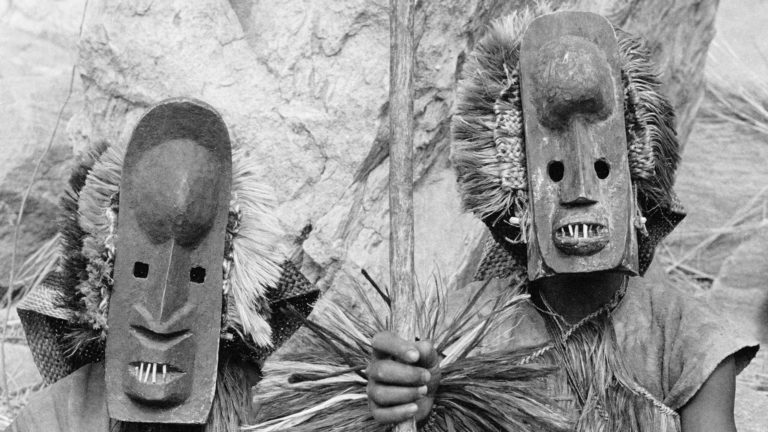
The Dogon, meanwhile, believe that words can smell of the aroma of a well-prepared dish. Nasal speech is associated with witches — this kind of speaking, according to them, smells… of decay. Words become stuck between the nose and the throat, unable to properly get out; the trapped words begin to rot in the body, causing madness. A ritual characteristic of this culture comes to the rescue — a person who still cannot speak properly is subjected to a ritual piercing of the nose to free from the body the words that might otherwise undergo permanent disintegration. As a result, the tribe member’s breath is supposed to begin to smell sweeter, even pleasant. Words, slowly released from the body, begin to emerge silently to the outside and float in the air; a symbolic healing of the body and its internal organs takes place.
Members of the Desana tribe assume that every kind of sensoriality, including smell, embodies cosmic energy. They claim that heat and sunlight produce three basic colors that constitute a kind of energy: white signifies life force, yellow male power, and red female fertility. These three energies combine with the warmth of the air to produce a scent, which in turn gives rise to taste.
Despite the differences, one conclusion emerges — in each of the cultures mentioned, smell assumes the role of a link between what is real and what is spiritual. It seems that the sense of smell is not to be underestimated, because to a large extent our perception of the surrounding reality depends on it. So let us not forget to smell!













































 Proceed to Checkout