Piękna koncepcja
Scent in the radio space. Aēsop's scent broadcasts.
Radio, quite unexpectedly, becomes one of the intriguing media creating specific olfactory experiences.
Text: Zuzanna Sokołowska
Photos: Materiały prasowe
17 • 04 • 2023
Can scent impressions be conveyed through sound? It turns out they can! That radio can become an excellent medium for stimulating the sense of smell is what the brand Aēsop seeks to demonstrate, having decided to create entirely original scent broadcasts. They have been regularly produced as part of a collaboration with Worldwide FM radio since 2022. This special series of programs, titled Radiomatique Mixtapes, is closely linked to both the perception and the experience of scents.
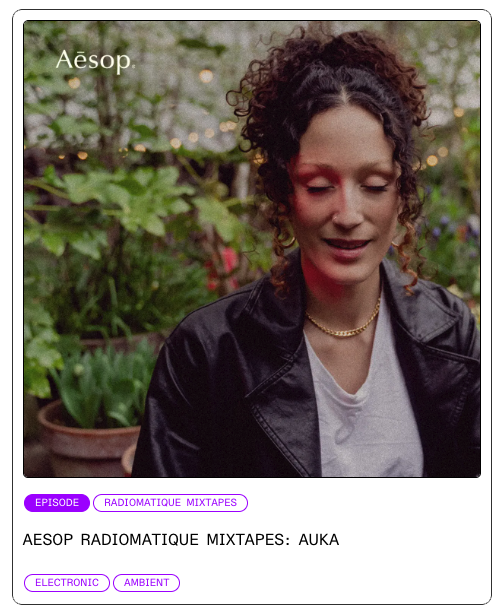
Scent, like music, has a multi-layered structure whose pinnacle is perfume, and whose individual layers are called notes. This kind of terminology, still in use today, was introduced by perfumer and chemist Septimus Piesse at the end of the 19th century. Piesse argued that a perfumer can create a bouquet by selecting aromas corresponding to a harmonious chord in music. And so, thanks to the extremely creative idea of the brand Aēsop, we can literally "listen" to a scent.
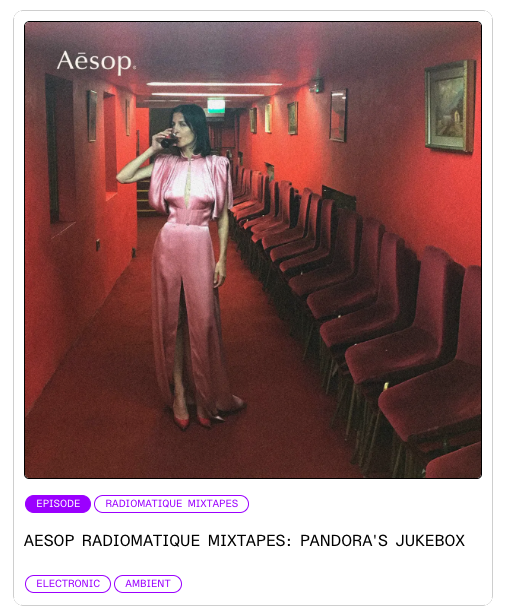
Each installment of Radiomatique Mixtapes lasts about 60 minutes. The show's theme focuses primarily on promoting the new, steadily expanding Othertopias collection, which currently includes perfumes named Miraceti, Karst, Erémia and the newest Gloam, which tell stories about spaces, both real and imagined, redirecting the sense of smell to the "inside," into the depths of memory and emotion.
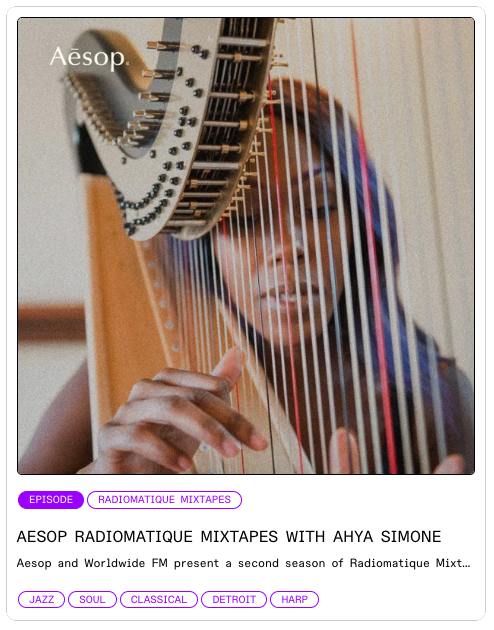
Musicians were invited to collaborate on this project, including Sofia Bertomeu, Shii, Closet Yi and Nedda Sou, who regularly create conceptual electronic music. Each of them, specially for the program, prepares a playlist encompassing various forms and genres, through which they translate olfactory experiences into sounds — a personal (re)interpretation of the impressions evoked in them by the scents created by Aēsop. This strategy of presenting experiences can confidently be described as "smelling voices" — after all, listeners are presented with a direct message that someone has experienced a particular scent. They can not so much smell it as imagine it. And here it is worth paying attention to the very process of sensing a scent through remembering — when we summon a particular aroma in our minds, without actually experiencing it in real time, very strong impressions arise not only in the nose but also on the tip of the tongue. Radio, therefore, quite unexpectedly, becomes one of the intriguing media shaping specific olfactory spaces.









































 Proceed to Checkout